Today for our Staff meeting we have our Mathematics Advisor, Sue Pine come to talk to us. Today our focus was planning for Evidence.
How can we collect evidence for Mathematics instead of relying on GLOSS?
Rely more on classroom evidence and information of students learning in the class.
What do we need to cover to get to the assessment tasks.
Unpacking/mapping a task. Identifying what they need to be able to do in order to get to where they should be.
How the child approaches the tasks shows us where the child is at.
What is the Maths language to be able to perform the tasks.
What are the measurement concepts (standards)
What are the number concepts/strategies/demand.
We looked at illustrations from NZ Maths site and looked at how we could tell the difference from year 6, 7, 8.
Above is the illustration of what a child should be able to do at the end of year 6.
Here is an illustration of what a child should be able to do at the end of year 7.
Here is what a child should be able to do at the end of Year 8.
Curriculum Elaborations-This rubric can be used as a form a assessment analysis for target children and finding where they sit and where the GAP to be able to accelerate Target children from Maori Backgrounds.
I found this meeting really informative as having these examples will really help me with my planning as well as being able to collect information for Mathematics. It was really good to be able to have a look at the different stages and being able to compare and spot the differences in the stages the strategies that children use at those stages.
This weekend I had the opportunity to be part of the NZEI Beginning Teachers Hui in Wellington. I was very excited as I have not been on a plane in a while and I LOVE the feeling of flying and being amongst the clouds like a free bird...the world certainly looks different from up high.
I was off to a start, I had arrived at the Domestic Airport not knowing that I had to check in 2 hours before, so lol lucky me had to be rushed so that I could board this plane on time.What an entrance right? Onboard I met few of the teachers from Auckland that I would be on this journey with. What an amazing experience to meet all these teachers and share out experiences and make new friends.
I was lucky enough to experince staying at his wonderful Marae where we all spent a couple of days getting to know each other and have professional development in many different areas.
The feeling of just being at this Marae words can not express. Such a beautiful and unique building.
Below I have included some history of Tapu Te Ranga Marae.
TAPA TE RANGA MARAE
When I heard the Korero behind the Marae it brought tears to my eyes. It was build by young unemployed Maori which some of them were homeless. They needed to have a place to make a stand. It has been said she is the largest and highest wooden house built of recycled materials on wooden piles anywhere on earth. It was designed by Bruce Stewart - all in his head because he cannot draw. Without formal training, he is a product of the kiwi 'do-it yourself' stuff. He had been influenced by architecture without architects - peasants building from local materials or what ever they could lay their hands combined with the principal of the theory of alchemy (making something from nothing) It grew like Topsy.Bruce could see the local material was from the demolition of much of Wellington. He together with the young people grabbed the bits, pulled out the nails and straightened them to use again. Doors, windows and timber, much of it heart native were being pulverised and thrown into the tip. Car cases from Todd Motors were also used once and taken to the tip. They were from trees of the tropical rain forest - hardwoods. Bruce got permission to use them. He believes building, using recycled material is spiritually in tune and uplifting.
The late Stan Hyde, demolition contractor, donated considerable fittings to The Marae as did many of the people of Wellington.
The 'non-traditionalness' of design of Tapu Te Ranga has often been mentioned. Bruce found there were many Whare of non-traditional design, some of them being Rua Kenana's Beehive in The Urawera and Potatau Te Whero Whero's whare at Te Awamutu.
The design shape is that of a cluster of whare grouped together representing The Mother and her children. Because it was built of recycled materials it was slow going - it has taken thirty two years.
Pare Hinetai No Waitaha is 26.5 meters high…she is on ten levels…she is 27,000 square feet. (Derived from Tapa Te Runga Website) What a fascinating experience to have heard it from the man that actually build the Marae with his bare hands. When we arrived we got outselves settled and then we had intriductions. It was a great opportunity to get to know each other more and share out backgrounds. Once we had settled in, after thr introductions is when we had our workshops. Firsty, we had one on wellbeing. Being new Teachers, having the balance of workload as well as wellbeing can be hard. So I found this workshop really helpful. I have listed some of the things that the Doctor talked to us about.
Growing your Wellness mindset-Doctor Mark Cunningham
Teachers being at high risk in the area for health care.
Wellness-loving yourself creating health-Up most importantance.
The Butterfly affect
Creating health-What would the world be like if everyone were wellness focused?
Growing your wellness mindset-Most important- and fostering it.
Your well being is important- 1: work place stress, The butterfly effect.
Single tools for well being: Give someone a fish or teach someone how?
Tool 1:Your wellness account- Lets gear it up..you're human. Body is amazing!!!!
50 trillion cells, fast generation rather, rebuilding a new you-Its cellular biology!!
Your personal environment: Happy environment= cell grow, generate and thrieve.
Unhappy environment=more cell death and slower geneation.
Your wellness account-You tube video.
He talked about making positive choices-Taking baby steps.
Tool2: Balancing your autonomic nervous system: Understanding the stress responses=elicit the relaxation response. How do we stimulate this? Below are some suggestions:
Walks, yoga, tai chi, edidation, reading, mindfullness, deep breathing, talking to loved ones, moving mindfully, eating clean, postutal awareness, good hydration, plenty of sleep, contentment, staying present, a positive mindset....and lots more.
Walking mindfully for teaching- And and importance of acknowledging the feeling of the moment-Positive feelings.
The more relaxed we are the more we can function better.
Wellness mindset= is linked to your well being.
A wellness mindset rather than sickness mentality:
our bodies speak out minds
our minds play tapes of learnt behaviours.
Its all about that self-love.
When we're present, we're cultivating contentment.
Act-Rather than react.
Its all about here and now!!!-
BE MINDFUL NOT MINDLESS!! Present and engaged in the moment.
The Subconscious mind is very powerful.
They say thoughts are things.
You are important in changing the world. You can influence the kids learnt behaviours for the better.
Different brain wave patterns for different ages.
Catching our thoughts and knowing how to change them.
Tool3: Mindful moment.
Set a timer and do it on a daily basis. Do it with the class.
Breathing exercises.
Your wellness account-LETS GROW IT
balance your system by relaxing when you can.
cultivate contentment by nurturing a wellness mindset.
One of the workshops that I chose to do during the Hui experience was "Working with children with special needs and behavioural needs. I have listed my notes as per below.
Workshop 1: Working with children with special needs and behavioural needs
PASSION: every child in NZ having the right to high quality education from ECE and beyond.
Knowlede, understanding, strategies.
Classrooms- Are complex places where children need to understand-hidden expectations for young children.
Inclusive education: full participation and achievement of ALL learners. Participation in learning in an environment where they have a sense of belonging.
What does this type if environment look like:
Welcoming/supportive and safe-physically and emotionally.
Fostering their identity and culture.
Working at an app. level for all students.
partnership with whanau and other agencies to support learners
Are children just naughty or needing support?
How we frame children with special education needs is very important.
Do we see them as children with disabilities?
Are these children naughty or do they need extra support being shown in a different way?
Knowing the child and knowing the child's needs and finding ways to meet them.
Making meaningful connections-Whanaungatanga
Children learn through responsive, respectful and reciprocal relationships with people, places and things
Connections with students everyday-ask how they are and really listen to them.
Chat with them regularly and get to find out about their lives.-likes/dislikes? what is important to them.
Call on students eqiutiably to contribute to class discussions.
Engaging leanring programmes: Te Marautanga O Aotearoa.
Reflective question
Would you want to be in your classroom as a student?
Structure and predictability
Important to ease children with anxiety or who are uncertain about the environment and people around them.
-Visual timetables.
-Follow same routines.
-Knowing ahead of time when things have changed.
Most of these behaviours have a patterns-Transition times, after lunch time.
Teaching expected behaviours: If we want stduents to learn in a particular way then we need to teach them.
Model
Explain
support
rehurse
repeat.
Feedback: Throughout this entire teaching process you are monitoring and giving ongoing feedback-Make it specific to the children.
Does your education setting explicitly teach children about expected behaviours?
Positive reinforcements and rewards systems:
-Behaviours do not change if there is no incentive to do so. When students are taught new behaviours they need to be continually encouraged to become habitual.
-Free and frequent- Smiles, high fives, etc)
-Moderate/intermitted- sticker charts etc)
Natural conseuences.....no punishment
Behaviours have natural consequences. eg: If I smile you smile. This sort follows newtons law that "Every action has an equal and opposite reaction"
Always refer to the consequences a=b and do not deviate because you are tired and fed up.
Ecological Model-Brofren brenna.
1. The Micro System
The micro system's setting is the direct environment we have in our lives. Your family, friends, classmates, teachers, neighbors and other people who have a direct contact with you are included in your micro system. The micro system is the setting in which we have direct social interactions with these social agents. The theory states that we are not mere recipients of the experiences we have when socializing with these people in the micro system environment, but we are contributing to the construction of such environment.
2.The Mesosystem
The mesosytem involves the relationships between the microsystems in one's life. This means that your family experience may be related to your school experience. For example, if a child is neglected by his parents, he may have a low chance of developing positive attitude towards his teachers. Also, this child may feel awkward in the presence of peers and may resort to withdrawal from a group of classmates.
3.The Exosystem
The exosystem is the setting in which there is a link between the context where in the person does not have any active role, and the context where in is actively participating. Suppose a child is more attached to his father than his mother. If the father goes abroad to work for several months, there may be a conflict between the mother and the child's social relationship, or on the other hand, this event may result to a tighter bond between the mother and the child.
4.The Macrosystem
The macrosystem setting is the actual culture of an individual. The cultural contexts involve the socioeconomic status of the person and/or his family, his ethnicity or race and living in a still developing or a third world country. For example, being born to a poor family makes a person work harder every day.
5.The Chronosystem
The chronosystem includes the transitions and shifts in one's lifespan. This may also involve the socio-historical contexts that may influence a person. One classic example of this is how divorce, as a major life transition, may affect not only the couple's relationship but also their children's behavior. According to a majority of research, children are negatively affected on the first year after the divorce. The next years after it would reveal that the interaction within the family becomes more stable and agreeable.
These things are very important:
Collaboration-working together.
Student voice.
Working with whanu/families.
Inter-agencyapproch.
Continual communication.
Functional behavioural Analysis-What is the function of the behaviour.
collecting data-Situational analysis
Having raw data to back up your presumptions about certain behaviour.
1 or two top behaviours of concern-How many times is it happening a day
What time of the day is it happening?
IEP- Setting SMART goals.
Whats more imp. a child listening to you and following instructions or a child being able to self regulate themselves.
POSITIVE relationships with children
TEACH the positive behaviours you want to see.
CHANGE be willing top change your practise.
REFLECT think about the child. whats happen, how often and why it is happening.
"Nurture the young as they are the future" Atawhaitia nga kohungahunga ko ratou hoki uri whaka tipu I really did enjoy this great experience at the Hui and I made some great friends on this journey, I look forward to going back again next year. I leant a great deal from balancing work and health to behaviour as well as catering for Maori and pasifica children and accelerating their learning as well as having collegial discussions in groups about arising issues that beginning teachers face. Most of all, I really enjoyed being part of a new family- new Whanau at the Marae, The lady of he Marae was Indian so I definatly connected with her. It was amazing to see how both cultures became one. Seeing her children and how they could speak both Hindi as well as Te Reo was amazing. We shared great stories and I look forward to seeing my Whanau again. They were very welcoming. The teachers enjoyed a great feast of beautiful Authentic Indian food which was amazing.
Today I attended the Digital immersion workshop. Today we looked at create to learn. Here is my Teaching as Inquiry video on create to learn. Hope you like it!
Enjoy. I really enjoyed using the app Video Scribe and look forward to using it in my classroom to create optimal learning.
What makes an effective teacher, that is the question? Today we had Jenny Thomas who is the Manager of Registration from the Education Council come visit us at Auckland University. Together as a team we went through the Graduating Teachers Standards. I have included a screen shot of the Standards below.
As an effective teacher under the Graduating Teachers Standards we as teachers should be covering three categories which are:
Professional Knowledge
Professional Practise
Professional values and relationships.
During this course I have covered a range of these standards. Some examples of these are below: Standard Six:
Graduating Teachers develop positive relationships with learners and the members of learning communities: I build good relationships with the other teachers in the TRC course. I had had collegial dicussions with the othe rteahcers regards to teaching as well as learning as we were also learners and learning news and extending out knowledge and learning. I worked positibely in group settings as well as helped other teahcers in regards to their learning and using a digital divise. Standard Seven: Graduating Teachers are committed members of the profession
I showed co-operatively by working with those who share responsibility for the learning and well-being of learners.
As teachers I believe that it is really important for us to always be reflective and always make sure that we come back to these standards as a reference and reflect on them so that we know we are meeting the standards.
It was really informative when the Education council representative came in and talked to all of us about the graduate teachers standards.
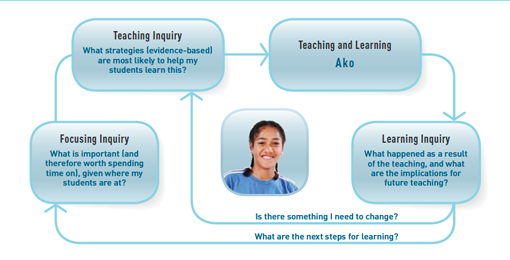
Today we looked at Teaching as Inquiry. Teaching as Inquiry is the Teacher Inquiring about their own teaching and practice and how they can accelerate the children's learning. The big thing that I leant about teaching as inquiry is that it is about the "HOW" factor-How we as a teacher can accelerate our students learning and what strategies we can use to be successful at this. This also involves ongoing reflection on our teaching and practice and refining areas of weakness.
Since any teaching strategy works differently in different contexts for different students, effective pedagogy requires that teachers inquire into the impact of their teaching on their students.
Ministry of Education, 2007b, page 35
The purpose of the Teaching as Inquiry cycle is to improve the outcomes for our students.
It also involves knowing your learner-What is knowing your learner?
To myself it means knowing the student and what they know and what their next steps will be and how can i help them in meeting their targets. Using evidence as well as overall teacher judgements such as their work and in class conversations and group conversations. Students also need to be aware where they are at so that they can work towards meeting their learning goals.
Why collaborate Inquiry (Reading)
By focusing efforts on professional learning approaches ccollaborative Inquiry for Educators. The definition of insanity is doing the same thing over andover and expecting different rresults.” (Benjamin Franklin) that challenge mental models and engaging people in learning and working collaboratively, individuals and organisations will be more likely to meet adaptive challenges. Teams works together to question, develop theories of actions, determine action steps, gather and analyse evidence to access the impact of their actions.
It had a measurable and significant effect on children's learning.
Teachers to take an active role in expressing and testing hypotheses and backed the notion that collaborative inquiry can have a profound impact on the professional practises not only of the participants but of their colleagues as well.
Collaborative 4 stage model for Inquiry
Stage 1: Framing the Problem.
During this stage, facilitators assist teams as they determine a meaningful focus, develop an inquiry about a particular link between professional practices and student results, and formulate a theory of action.
Stage 2: Collecting Evidence.
In the second stage, facilitators guide teams in developing shared understandings and building additional knowledge and competencies. Teams determine the type of evidence to collect. They also determine when, where, and how it will be collected.
Stage 3: Analysing Evidence.
Once teams feel they have gathered enough information to address the question posed, facilitators guide teams through a five-step approach to analysing evidence. Teams learn how to make meaning of data by identifying patterns and themes and formulating conclusions. As teams refine their thinking, they revisit their theory of action
accordingly.
Stage 4: Documenting, Sharing, and Celebrating.
During this final stage, teams come together to document, share, and celebrate their new under-
standings. Teams consider next steps by identifying additional student learning needs and reflecting on what they learned through their inquiries. Finally, teams debrief the process by considering how their work was reflective of the characteristics of collaborative inquiry.
We worked in teams after doing numerous amounts of readings in Teaching as Inquiry. We than came together to create a fish bone on what Teaching as Inquiry is to us. We collaborated out ideas together form our readings and put it onto paper. Below I have included photos of the different teaching as inquiry fish bone activity.
Today was really helpful in regards to learning about Inquiry as teaching. Inquiry as teaching is about the teacher and refining and reflecting on our teaching so that we are able to cater as well as accelerate the children that are in the priority/target group. This involves a whole process of: Knowing the learner, having the strategies, refinement, collaboration as well as many other aspects.
Today we looked at Literacy and the literacy learning progressions.
We were given a journal article: Family photographs to read on our own. We then were given a group follow up task to do in regards to the journal article that we had read. The lecturer using a really good learning tool which I had not used before, so I was great being able to learn a new interactive tool that I could use next term in my digital classroom.
I have listed the learning tool that was a a whole team used for the follow up activity.
Learning tool: Kahoot! Join at Kahoot.it- For reading activity-If done with the class there can be a prize for the the winning team.
Kahoot! can be used for deep thinking as well. Use between 6-7 questions. Kahoot! can show you the weakness in the class when you go to feedback and results as a form of assessment and where to next. This app is really good for teaching vocabulary as well as other areas of reading and curriculum areas. We also looked at ESOL online. This was familiar to myself as at our School have had ELLP professional development and training as a whole staff on how to do these forms. Below is a link to teaching literacy strategies which I also found useful today. There are helpful DVDs which show literacy strategies. ESOL online- Teaching literacy strategies.
The Making Language and Learning Work DVDs demonstrate how to effectively integrate content-area teaching and language learning in mainstream subject classrooms for students from diverse language backgrounds. They show how to integrate effective literacy strategies, and how a range of teachers in different subject areas scaffold language and content area learning. The materials model how to personalise learning by supporting students at different levels of English proficiency in a manageable way in mainstream classes (TKI website)
We also looked ESOL teaching strategies which I found helpful. We also looked at the New Zealand Curriculum thoroughly and looked at an exemplar of a Unit plan and looked at how we could annotate and justify why we chose the learning outcomes, key competencies etc.
We also looked at "Scenario's around curriculum levels" and had to justify in collegial discussions if we agreed if the students were put at the right level or not and why.
Today at University we worked together in groups and talked about "What does an ideal School look like. In my group we decided to draw our school out and put out ideas together. This was a fun activity together and be able to talk together and share out ideas-Learn, create, share.
Here is our plan for our Ideal School below.
As you can see from our plan we decided on a range of things to include in our School such as outdoor learning areas, specialised learning classes for Languages, Art, Music etc. We also thought it would be great to be inclusive and include a Satillite classroom where children with special needs could be included in a mainstream setting. In that classroom we included sensory areas so these children were able to have a sensory diet as part of their learning programme enabling them for better learning.
It was very interesting to see the different range of Schools that the other teachers came up with. It was great to see that one group had a mission statement on their School designs. It was also interesting to see how the other teachers were inclusive of other learning areas and needs for the children. I really enjoyed collaborating ideas with my group as well as sharing ideas with the other teachers.
 Today for our Staff meeting we have our Mathematics Advisor, Sue Pine come to talk to us. Today our focus was planning for Evidence.
 Here is an illustration of what a child should be able to do at the end of year 7.
 Here is what a child should be able to do at the end of Year 8.
 This weekend I had the opportunity to be part of the NZEI Beginning Teachers Hui in Wellington. I was very excited as I have not been on a plane in a while and I LOVE the feeling of flying and being amongst the clouds like a free bird...the world certainly looks different from up high.
 The late Stan Hyde, demolition contractor, donated considerable fittings to The Marae as did many of the people of Wellington.




 Today at University we worked together in groups and talked about "What does an ideal School look like. In my group we decided to draw our school out and put out ideas together. This was a fun activity together and be able to talk together and share out ideas-Learn, create, share.
